








Curley’s wife is an unnamed young woman in John Steinbeck’s 1937 novel Of Mice and Men, a newlywed on a California ranch who dreams of becoming a movie star. Steinbeck never gives her a first name. She is known only by her husband’s name, and that choice is central to her story.
Of Mice and Men follows two migrant workers, George Milton and Lennie Small, during the Great Depression. Steinbeck’s short novel is one of the most widely taught books in American schools. Curley’s wife appears in only a few scenes, yet she shapes the book’s tragic ending.
This article covers who Curley’s wife is, her background and dreams, her marriage to Curley, her role in the plot, and how actresses have played her on stage and screen. It ends with a quick facts table and answers to common questions.
Who Is Curley’s Wife in Of Mice and Men?
Curley’s wife is the only woman on the ranch in the Salinas Valley where George and Lennie find work. She is very young, and Steinbeck describes her as having heavy rouge, red fingernails, and sausage-like curls in her hair. She wears a cotton house dress and red shoes decorated with ostrich feathers.
Her most striking trait is her lack of a name. Steinbeck calls her “Curley’s wife” every time, and the ranch hands refer to her the same way. Many readers see this as a comment on how women in the 1930s were defined by their husbands. In the 1939 film version, she was given the name Mae, but the novel never does this.
There is no birthdate or birthplace in the book. The text only shows that she is a teenager or very young adult. She grew up in a small town and says she lived with her mother. She also tells Lennie she once wanted a different life.
Her education is never mentioned. She speaks plainly, and the story suggests she had few chances to build a career or move far from home.
Curley’s Wife’s Dreams, Personality & Role in the Story
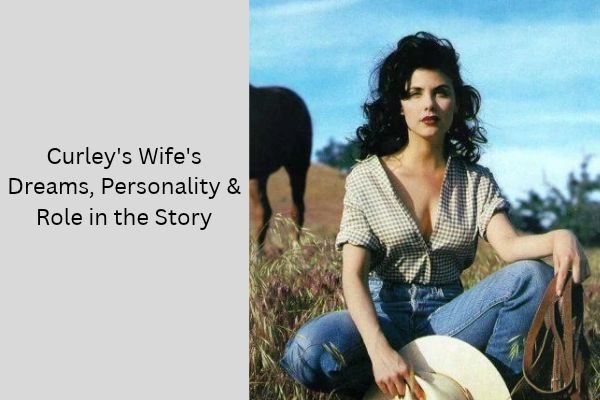
Instead of a career, Curley’s wife has a dream. She tells Lennie that she once met a man from a traveling show at the Riverside Dance Palace. He said he could get her into the movies. She waited for his letter, which never came, and she believes her mother may have kept it from her.
This dream explains much of her behavior. She is lonely and ignored by her husband, so she looks for conversation with the ranch workers. Because of this, she often turns up in the bunkhouse or the barn, which makes the men suspicious of her. Her husband Curley is jealous, aggressive, and quick to fight.
Readers often disagree about her character. Some call her flirtatious and a troublemaker, which is how the ranch hands see her. Others see a lonely young woman trapped in a bad marriage, with no friends and no future. Steinbeck himself later said in letters that she was not a villain but a girl with an unfulfilled dream.
She also shows cruelty. In the scene with Crooks, the Black stable hand, she threatens to have him lynched, which shows how little power Crooks has in that world. In this moment, the book shows that even someone with little power herself can use the racism of the time against someone with even less.
Her death is the turning point of the novel. In the barn, she lets Lennie stroke her hair. When she panics and cries out, Lennie accidentally breaks her neck. Her death leads directly to the book’s final scene. As for net worth, she has none. The couple lives in a ranch bunkhouse setting, and she owns almost nothing besides her clothes and a few trinkets.
How Did Curley and His Wife Meet?
Steinbeck never describes how Curley and his wife met. We only know they have been married for about two weeks when George and Lennie arrive. Curley is the son of the ranch boss and a former boxer who likes to pick fights with bigger men.
From the little the book reveals, the marriage was rushed. Curley’s wife says she did not love him and that she married him after meeting him at a dance. She tells Lennie she doesn’t like Curley and implies she married out of disappointment after her movie dream failed.
There is no engagement story and no dating timeline in the book. Readers only see the result: a young bride who is already unhappy and a husband who spends more time checking on her than speaking with her. Curley wears a glove filled with Vaseline on one hand, which the workers whisper is meant to keep his hand soft for his wife.
Curley’s Wife’s Marriage and the Ranch Setting
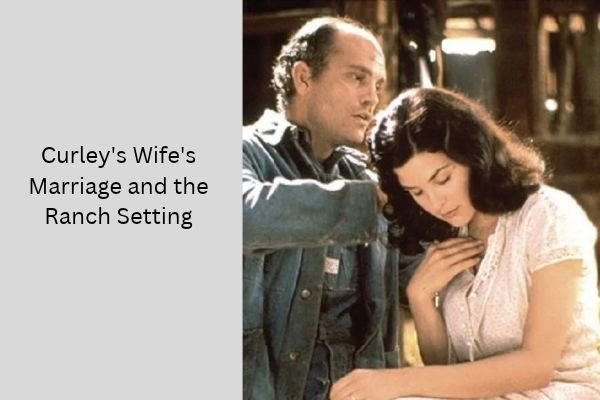
There is no wedding scene in the novel. The setting is a ranch near Soledad, California, during the Great Depression, a time when thousands of workers traveled for temporary jobs. This explains why Curley’s wife has no female friends. Women were rare on ranches, and the workers were told to stay away from the boss’s son’s wife.
The marriage is tense from the beginning. Curley is possessive and often goes looking for her. She, in turn, seeks attention from other men. Candy, the old swamper, and the other hands warn George and Lennie to stay away from her, calling her trouble.
The book’s most memorable moment for her is a quiet one. Alone with Lennie in the barn, she finally talks freely about her dream. It is the only scene where she speaks without worrying about being judged. That makes her death more tragic.
Children & Family Life
Curley’s wife has no children in the novel. Her family appears only in her own memories. She mentions her mother, who she believes took the movie letter. She says nothing about a father or siblings.
After her death, Curley reacts with rage rather than grief. He leads the men to hunt Lennie. Steinbeck does not describe any funeral, mourning, or later family life for her. This leaves her as a character known mostly through absence: she has no family, no name, and no ending beyond the barn.
Curley’s Wife on Stage and Screen (Instead of Social Media)
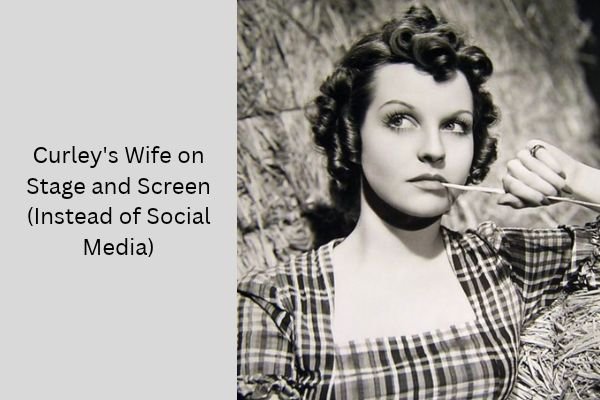
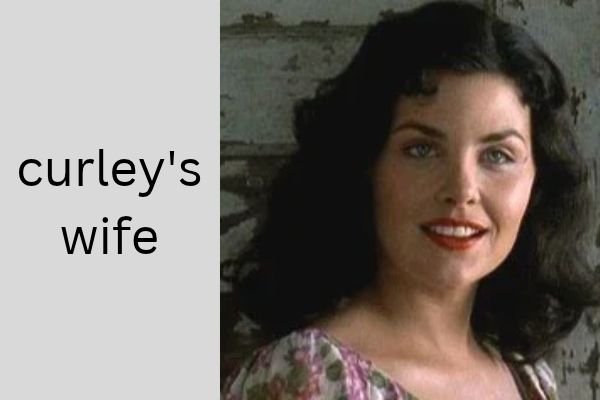
As a fictional character, she has no Instagram or social media accounts, but she has been played by many actresses over the years. In the original 1937 Broadway production, the role was played by Claire Luce. In the 1939 film, Betty Field played her. In the 1992 film adaptation directed by Gary Sinise, Sherilyn Fenn took the role.
Each version places a different emphasis on her. Some portray her as a flirt and a danger to the men. Others give her more sympathy, showing her loneliness and ambitions.
Her character is also a frequent subject of school essays, study guides, and online discussions. Students often write about her red dress, her dream of Hollywood, and her lack of a name.
Quick Facts About Curley’s Wife
| Detail | Info |
|---|---|
| Full Name | Not given in the novel (called “Mae” in the 1939 film) |
| Date of Birth | Not stated; she is very young |
| Nationality | American (fictional) |
| Profession | None; dreams of being a movie actress |
| Married to | Curley, the boss’s son |
| Marriage Year | About two weeks before the story (1930s setting) |
| Children | None |
| Net Worth | Not applicable |
| Created by | John Steinbeck, Of Mice and Men (1937) |
FAQ: Curley’s Wife
Q: What is Curley’s wife’s name?
A: Steinbeck never gives her a name in the novel. She is only called “Curley’s wife,” and the 1939 film named her Mae.
Q: How old is Curley’s wife?
A: The book does not give her exact age. She is described as very young, likely a teenager or in her early twenties.
Q: What does Curley’s wife do for a living?
A: She has no job. She wanted to be a movie actress but ended up married and living on a ranch.
Q: When did Curley and his wife get married?
A: They had been married only about two weeks when the story begins. The book is set in the 1930s.
Q: How many kids do Curley and his wife have?
A: They have no children. She dies before the end of the story.
Conclusion
Curley’s wife may never be given a name, but she is one of the most discussed characters in American literature. She is a lonely newlywed whose dream of Hollywood never came true, and her story raises questions about loneliness, power, and how women were treated in Depression-era America. Readers still debate whether she is a villain or a victim, which is part of why Steinbeck’s brief portrait lasts. Understanding who Curley’s wife really is gives Of Mice and Men even greater depth.